Disclaimer: This article is intended solely for informational and educational purposes only. It does not constitute medical advice.
Local anesthetics provide targeted blockade of nociceptive pathways for perioperative pain management. They can be used topically, intravenously, and in targeted injections near nervous tissue for regional anesthesia. Anesthesia care also includes many other medications for various uses, such as the prevention of nausea and vomiting, which is a common side effect that has a significant impact on patient recovery and comfort. Although primarily prescribed as antiemetics, 5-HT3 receptor antagonists possess intrinsic analgesic and local anesthetic properties that may complicate the effect of conventional local anesthetics such as lidocaine.
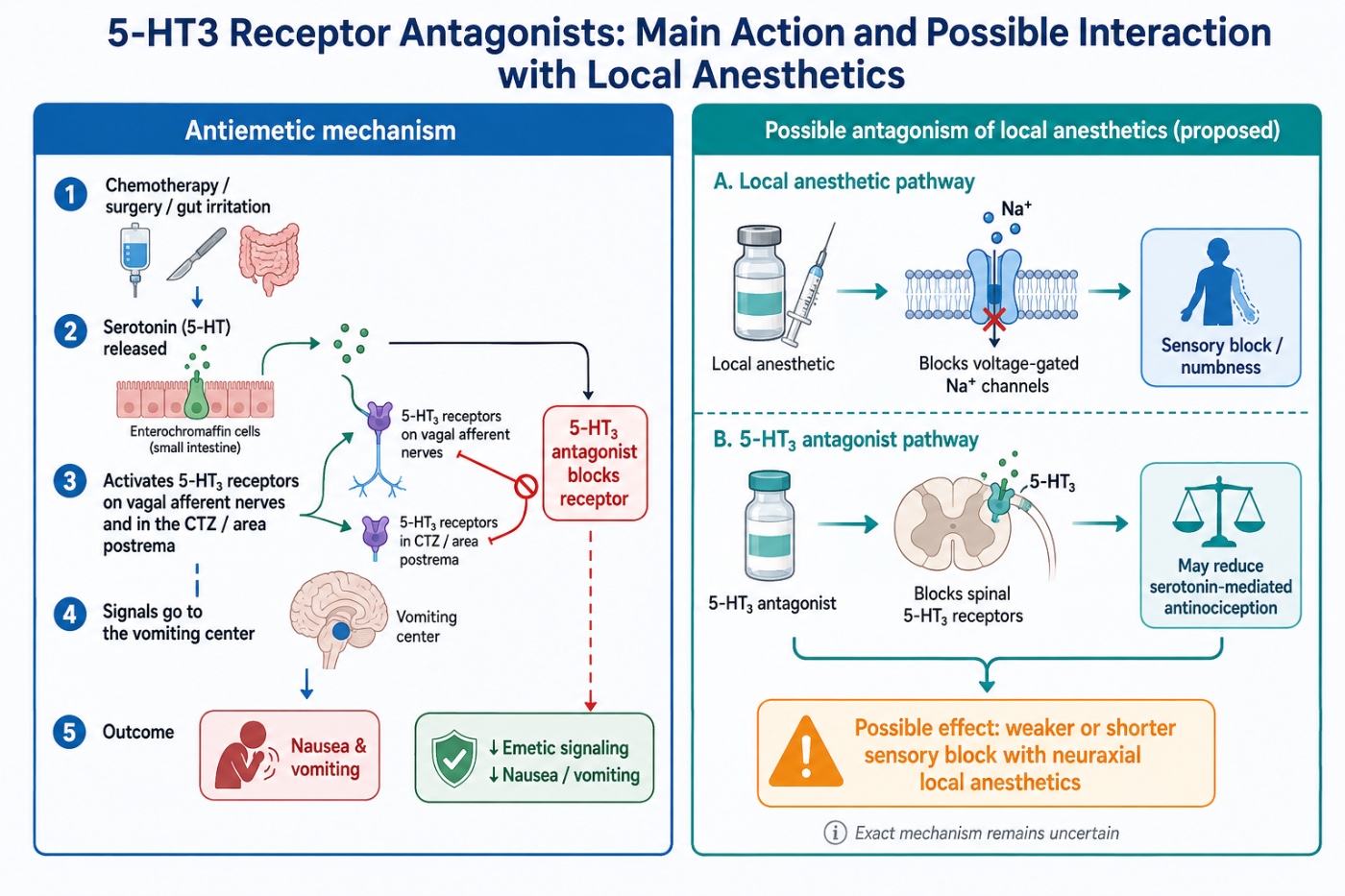
The primary pharmacologic action of 5-HT3 receptor antagonists is the competitive inhibition of serotonin (5-hydroxytryptamine, 5-HT3) receptors located in both the gastrointestinal tract and the central nervous system. Following tissue injury or surgical trauma, serotonin is released from local cells, where it activates 5-HT3 receptors on local sensory neurons. This activation contributes to both emetogenic signaling and peripheral nociceptor sensitization. By blocking these receptors, this class of drugs attenuates serotonin-mediated neuronal excitation and reduces peripheral pain signaling while simultaneously suppressing nausea and vomiting.
Beyond their serotonergic effects, 5-HT3 receptor antagonists exhibit local anesthetic activity through a distinct mechanism. Electrophysiologic studies have demonstrated that ondansetron directly inhibits voltage-gated sodium channels in a dose- and voltage-dependent manner (Ye et al., 1997). Because inhibition of voltage-gated sodium channels is the principal mechanism by which lidocaine prevents neuronal depolarization and action potential propagation, ondansetron may augment the effects of conventional local anesthetics through complementary sodium channel blockade.
These pharmacologic properties have generated interest in the use of 5-HT3 receptor antagonists in intravenous regional anesthesia (IVRA), or Bier block, which is commonly used for orthopedic and extremity procedures. One of the principal limitations of IVRA is tourniquet pain—a progressive neuropathic discomfort resulting from localized ischemia and mechanical compression of peripheral nerves beneath the pneumatic tourniquet. Clinical research has found that adding ondansetron to lidocaine improves the quality of regional anesthesia. Compared with lidocaine alone, patients receiving the combination experienced faster onset of sensory and motor blockade, lower intraoperative tourniquet pain scores, prolonged time to first rescue analgesia, and reduced perioperative analgesic requirements (Farouk, 2009).
Despite these potential benefits, other research has raised concerns about potential antagonistic effects when 5-HT3 receptor antagonists are administered alongside local anesthetics. For example, one study compared subarachnoid anesthesia induced via either lidocaine and ondansetron or just lidocaine. The researchers found that the addition of ondansetron resulted in quicker regression of the lidocaine-induced nerve block, measured by patient categorization of level of sensation (e.g., no feeling vs. some feeling) (Sarantopoulos et al., 2005). This may represent a unique feature of some central nervous system 5-HT3 receptors: they may actually mediate anti-nociceptive effects. Thus, blockade of these receptors via intrathecal injection can result in a paradoxical decrease in analgesia.
Given the mixed evidence and the potential for complications with the administration of any type of anesthesia, clinicians should remain aware of potential changes in analgesia provided by local anesthetics when 5-HT3 receptor antagonists are administered in parallel.
References
- Ye, J. H., Mui, W. C., Ren, J., Woolf, C. J., & Zhang, J. (1997). Ondansetron exhibits local anesthetic-like actions on voltage-gated sodium channels. Anesthesia & Analgesia, 85(5), 1116–1121.
- Sarantopoulos, C., Zotou, M., Melemeni, A., & Fassoulaki, A. (2005). Systemic Ondansetron Antagonizes the Sensory Block Produced by Intrathecal Lidocaine. Anesthesia & Analgesia, 100(6), 1817–1821. https://doi.org/10.1213/01.ANE.0000152616.57107.F6
- Farouk, S. (2009). Ondansetron added to lidocaine for intravenous regional anaesthesia. European Journal of Anaesthesiology, 26(12), 1032–1036.