Disclaimer: This article is intended solely for informational and educational purposes only. It does not constitute medical advice.
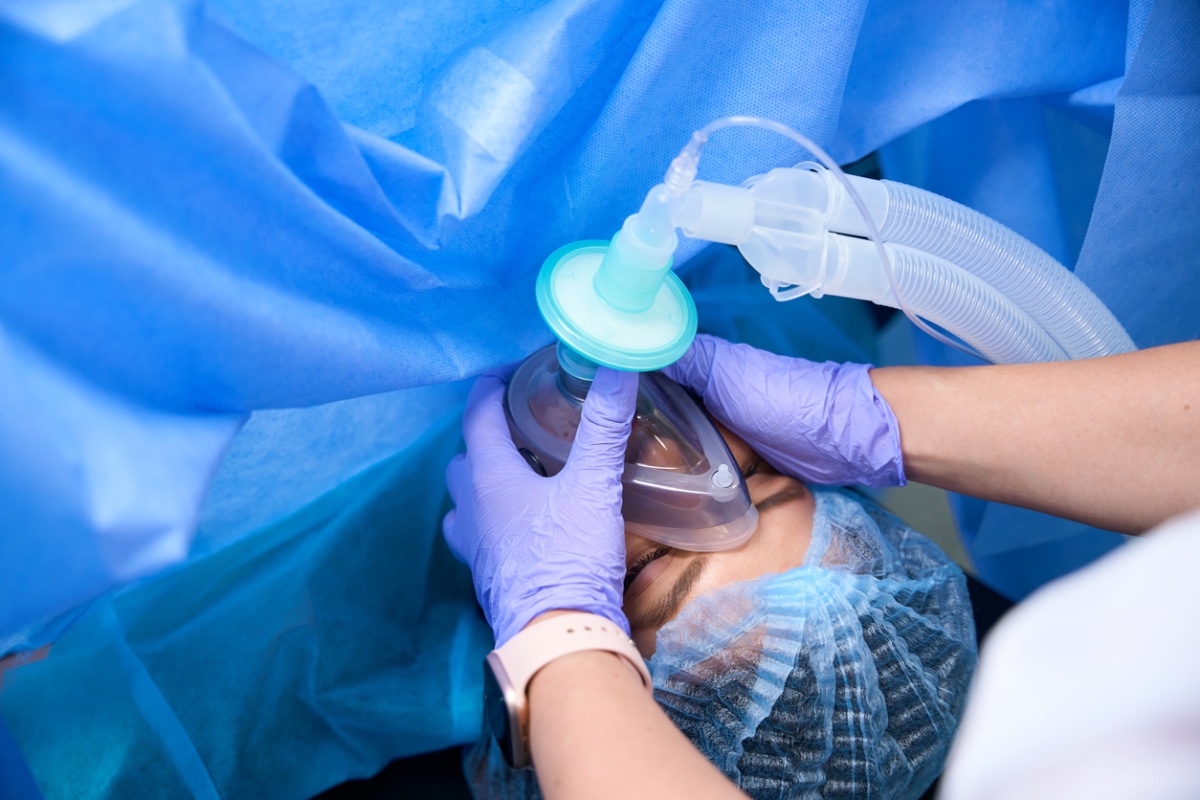
Face mask ventilation is a method of airway management during anesthesia care that provides oxygenation before endotracheal intubation, supports ventilation during short surgical procedures, and serves as a rescue technique when advanced airway placement is delayed or unsuccessful. Effective mask ventilation helps prevent hypoxemia while allowing time for airway assessment and appropriate intervention. Because failure to establish adequate ventilation can rapidly lead to oxygen desaturation and other serious complications, clinicians must be proficient in both the technical aspects of mask ventilation and the prompt recognition of ineffective ventilation (1).
Successful face mask ventilation depends on proper patient positioning, maintenance of an effective mask seal, and optimization of upper airway patency. The sniffing position is commonly used to improve airway alignment, although a ramped position may be more effective for patients with obesity. Upper airway obstruction resulting from relaxation of the tongue and surrounding soft tissues during induction of anesthesia can often be relieved with a jaw thrust. Oral or nasopharyngeal airways may be used when these maneuvers alone are insufficient. Ventilation should be evaluated by observing chest expansion or confirming exhaled carbon dioxide with capnography, rather than relying solely on movement of the reservoir bag (2).
Several patient characteristics increase the likelihood of difficult face mask ventilation and should be noted as clinicians form the anesthesia care plan for a patient. Obesity, obstructive sleep apnea, male sex, and limited mandibular mobility may interfere with an effective mask seal or contribute to upper airway obstruction. Careful preoperative airway assessment helps identify patients who may require airway adjuncts or alternative management strategies. Although no single bedside examination reliably predicts difficult mask ventilation, combining multiple clinical findings with the patient’s medical history improves risk assessment and allows for better preparation (3).
Proper technique is essential for effective ventilation. A single provider may achieve adequate ventilation using the traditional “C-E” grip, but a two-handed mask seal often provides greater stability and improves ventilation in difficult cases. This approach is particularly effective when the second provider delivers positive-pressure breaths. Excessive inspiratory pressures should be avoided because they increase the risk of gastric insufflation and pulmonary aspiration. Continuous monitoring with pulse oximetry and capnography allows clinicians to confirm adequate gas exchange and detect ventilation problems early (4).
Current difficult airway guidelines emphasize that maintaining adequate oxygenation should remain the primary objective throughout airway management. When face mask ventilation becomes inadequate, clinicians should promptly optimize patient positioning, insert appropriate airway adjuncts, and request additional assistance. If ventilation remains unsuccessful, placement of a supraglottic airway device should be considered before repeated attempts at endotracheal intubation. Following structured airway algorithms promotes systematic decision-making and reduces delays that could increase the risk of hypoxic injury. Regular simulation training also reinforces technical skills and prepares clinicians to manage airway emergencies effectively (5).
Despite advances in airway devices and visualization technologies, proper face mask ventilation remains an indispensable component of modern anesthesia practice. Consistent application of proper technique, early recognition of difficult ventilation, and adherence to evidence-based airway management principles help ensure adequate oxygenation and improve perioperative patient outcomes. As a result, proficiency in face mask ventilation continues to represent a core competency for anesthesia providers and remains an essential safeguard against preventable anesthesia-related complications.
References
- Kheterpal S, Han R, Tremper KK, et al. Incidence and predictors of difficult and impossible mask ventilation. Anesthesiology. 2006;105(5):885-891. doi:10.1097/00000542-200611000-00007
- Joffe AM, Aziz MF, Posner KL, Duggan LV, Mincer SL, Domino KB. Management of Difficult Tracheal Intubation: A Closed Claims Analysis. Anesthesiology. 2019;131(4):818-829. doi:10.1097/ALN.0000000000002815
- Roth D, Pace NL, Lee A, et al. Airway physical examination tests for detection of difficult airway management in apparently normal adult patients. Cochrane Database Syst Rev. 2018;5(5):CD008874. Published 2018 May 15. doi:10.1002/14651858.CD008874.pub2
- Law JA, Duggan LV, Asselin M, et al. Canadian Airway Focus Group updated consensus-based recommendations for management of the difficult airway: part 1. Difficult airway management encountered in an unconscious patient. Can J Anaesth. 2021;68(9):1373-1404. doi:10.1007/s12630-021-02007-0
- Law JA, Jones PM, Baker P, et al. Canadian Airway Focus Group updated consensus-based recommendations for management of the difficult airway: part 2. Planning and implementing safe management of the patient with an anticipated difficult airway. Can J Anaesth. 2021;68(9):1405-1436. doi:10.1007/s12630-021-02008-z